
Along the Santa Fe Trail
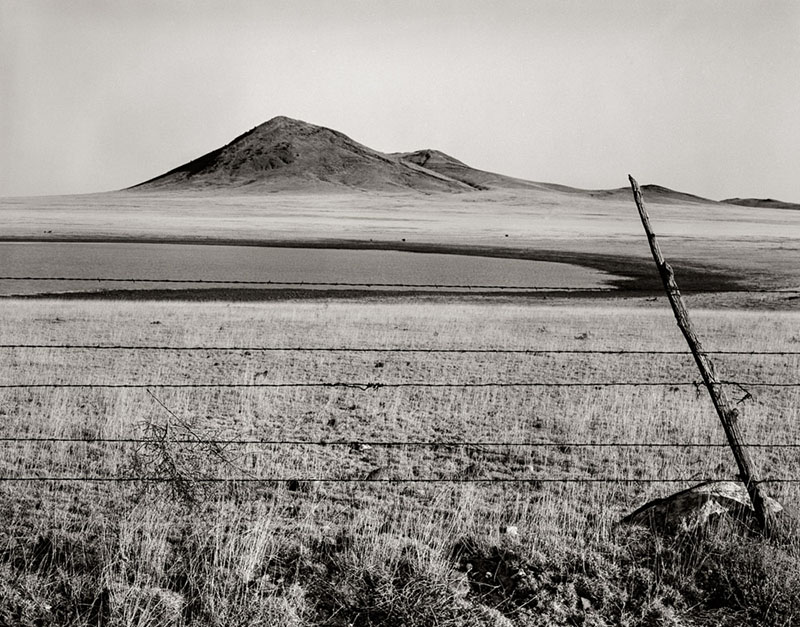
Round Mound, New Mexico
10 x 12.5″, platinum-palladium print with pastel
Prints are numbered and signed
“Joan Myers photographs of the Santa Fe Trail are the record of her travels on the nineteenth-century trade route between Santa Fe and Missouri, enriched and filtered by her unique perspective in this century. In 1822, William Becknell led the first freight wagons from Franklin, Missouri, through southern Kansas, down across northeastern New Mexico to Santa Fe, thus establishing the viability of a trade route soon known as the Santa Fe Trail. Thousands of traders and immigrants along with United States Army troops traveled the Trail until it was superseded by the railroad in 1880.” – University of New Mexico Press
Photographs by Joan Myers of the Santa Fe Trail were shown around the United States as part of a 3‑year SITES (Smithsonian Institution Traveling Exhibition Service) tour, 1986–1989. The book, Along the Santa Fe Trail, with text by Marc Simmons, accompanied the exhibit.
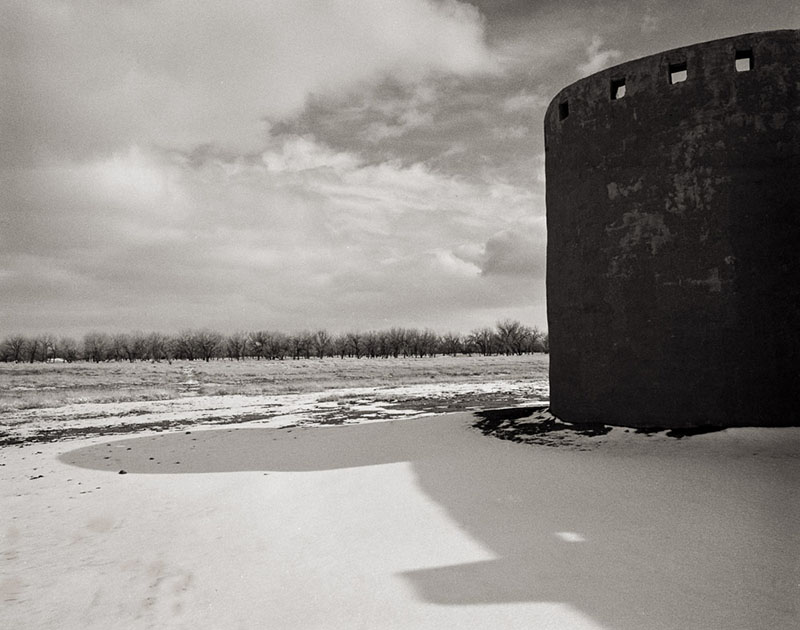
Bent’s Fort, Colorado
10 x 12.5″, platinum-palladium print with pastel
Prints are numbered and signed
“Joan Myers photographs of the Santa Fe Trail are the record of her travels on the nineteenth-century trade route between Santa Fe and Missouri, enriched and filtered by her unique perspective in this century. In 1822, William Becknell led the first freight wagons from Franklin, Missouri, through southern Kansas, down across northeastern New Mexico to Santa Fe, thus establishing the viability of a trade route soon known as the Santa Fe Trail. Thousands of traders and immigrants along with United States Army troops traveled the Trail until it was superseded by the railroad in 1880.” – University of New Mexico Press
Photographs by Joan Myers of the Santa Fe Trail were shown around the United States as part of a 3‑year SITES (Smithsonian Institution Traveling Exhibition Service) tour, 1986–1989. The book, Along the Santa Fe Trail, with text by Marc Simmons, accompanied the exhibit.
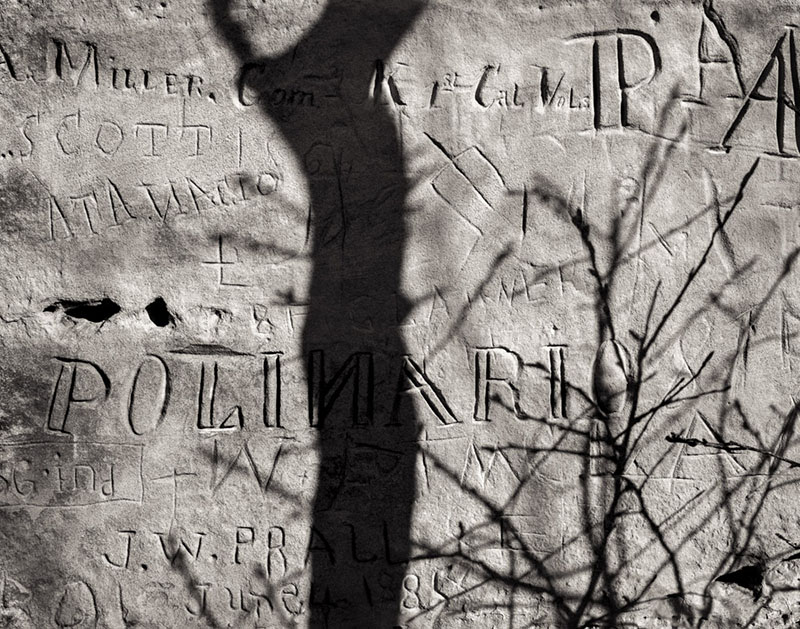
Inscription Rock
10 x 12.5″, platinum-palladium print with pastel
Prints are numbered and signed.
“Joan Myers photographs of the Santa Fe Trail are the record of her travels on the nineteenth-century trade route between Santa Fe and Missouri, enriched and filtered by her unique perspective in this century. In 1822, William Becknell led the first freight wagons from Franklin, Missouri, through southern Kansas, down across northeastern New Mexico to Santa Fe, thus establishing the viability of a trade route soon known as the Santa Fe Trail. Thousands of traders and immigrants along with United States Army troops traveled the Trail until it was superseded by the railroad in 1880.” – University of New Mexico Press
Photographs by Joan Myers of the Santa Fe Trail were shown around the United States as part of a 3‑year SITES (Smithsonian Institution Traveling Exhibition Service) tour, 1986–1989. The book, Along the Santa Fe Trail, with text by Marc Simmons, accompanied the exhibit.
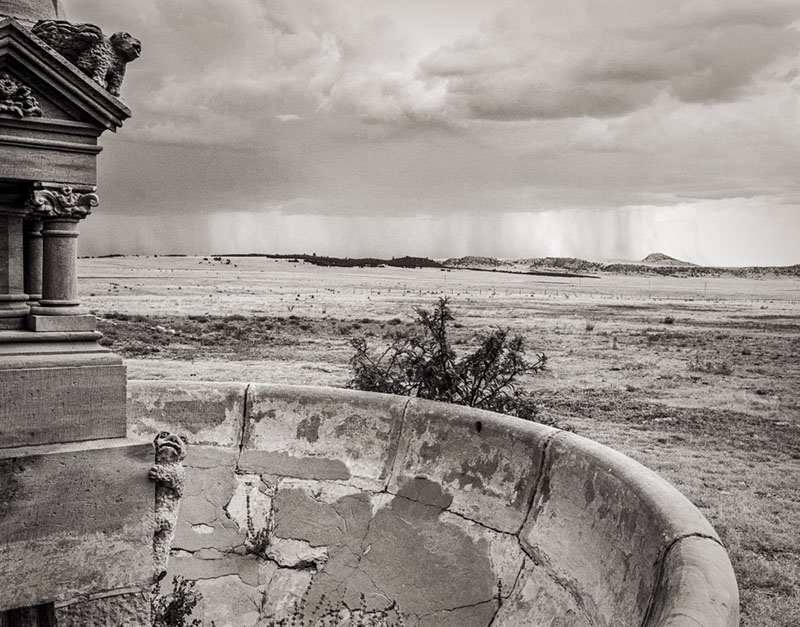
Dorsey Mansion, New Mexico
10 x 12.5″, platinum-palladium print with pastel
Prints are numbered and signed
“Joan Myers photographs of the Santa Fe Trail are the record of her travels on the nineteenth-century trade route between Santa Fe and Missouri, enriched and filtered by her unique perspective in this century. In 1822, William Becknell led the first freight wagons from Franklin, Missouri, through southern Kansas, down across northeastern New Mexico to Santa Fe, thus establishing the viability of a trade route soon known as the Santa Fe Trail. Thousands of traders and immigrants along with United States Army troops traveled the Trail until it was superseded by the railroad in 1880.” – University of New Mexico Press
Photographs by Joan Myers of the Santa Fe Trail were shown around the United States as part of a 3‑year SITES (Smithsonian Institution Traveling Exhibition Service) tour, 1986–1989. The book, Along the Santa Fe Trail, with text by Marc Simmons, accompanied the exhibit.
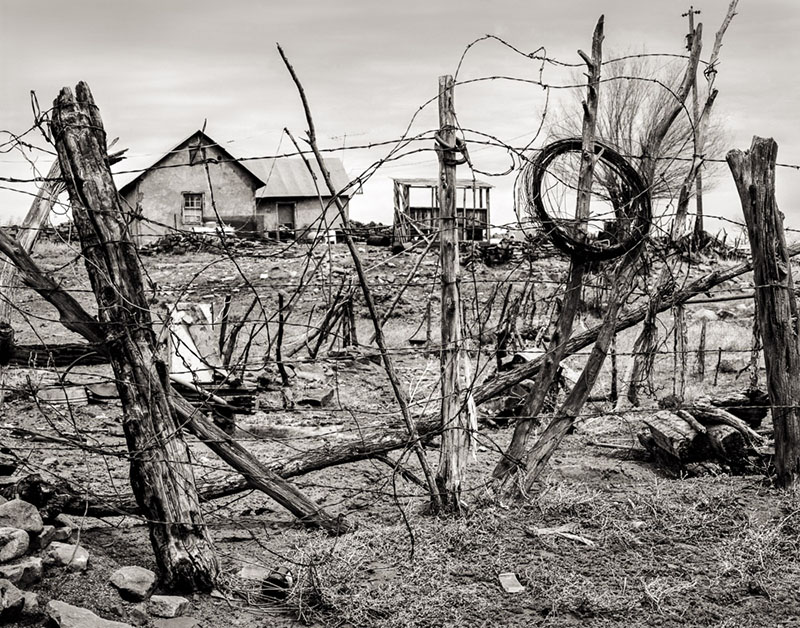
Tecolote, New Mexico
10 x 12.5″, platinum-palladium print with pastel
Prints are numbered and signed
“Joan Myers photographs of the Santa Fe Trail are the record of her travels on the nineteenth-century trade route between Santa Fe and Missouri, enriched and filtered by her unique perspective in this century. In 1822, William Becknell led the first freight wagons from Franklin, Missouri, through southern Kansas, down across northeastern New Mexico to Santa Fe, thus establishing the viability of a trade route soon known as the Santa Fe Trail. Thousands of traders and immigrants along with United States Army troops traveled the Trail until it was superseded by the railroad in 1880.” – University of New Mexico Press
Photographs by Joan Myers of the Santa Fe Trail were shown around the United States as part of a 3‑year SITES (Smithsonian Institution Traveling Exhibition Service) tour, 1986–1989. The book, Along the Santa Fe Trail, with text by Marc Simmons, accompanied the exhibit.
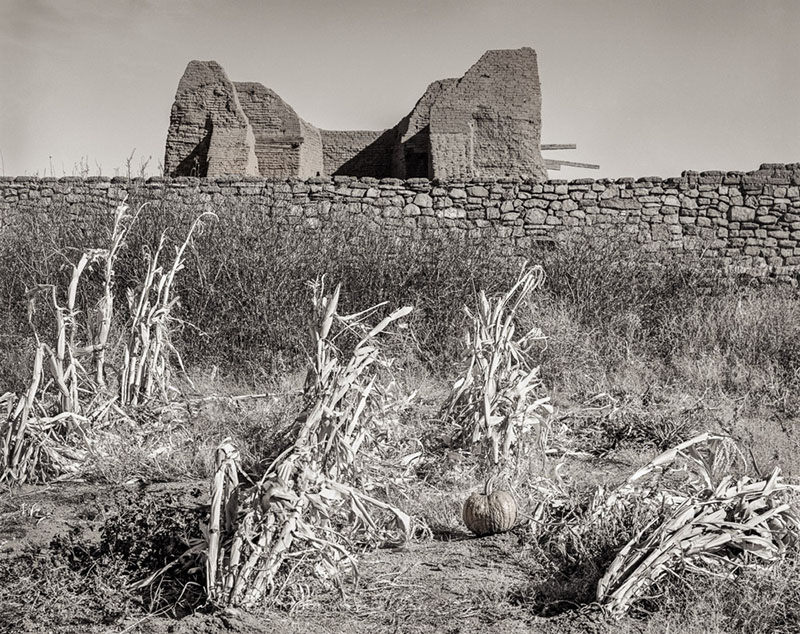
Pecos, New Mexico
10 x 12.5″, platinum-palladium print with pastel
Prints are numbered and signed
“Joan Myers photographs of the Santa Fe Trail are the record of her travels on the nineteenth-century trade route between Santa Fe and Missouri, enriched and filtered by her unique perspective in this century. In 1822, William Becknell led the first freight wagons from Franklin, Missouri, through southern Kansas, down across northeastern New Mexico to Santa Fe, thus establishing the viability of a trade route soon known as the Santa Fe Trail. Thousands of traders and immigrants along with United States Army troops traveled the Trail until it was superseded by the railroad in 1880.” – University of New Mexico Press
Photographs by Joan Myers of the Santa Fe Trail were shown around the United States as part of a 3‑year SITES (Smithsonian Institution Traveling Exhibition Service) tour, 1986–1989. The book, Along the Santa Fe Trail, with text by Marc Simmons, accompanied the exhibit.
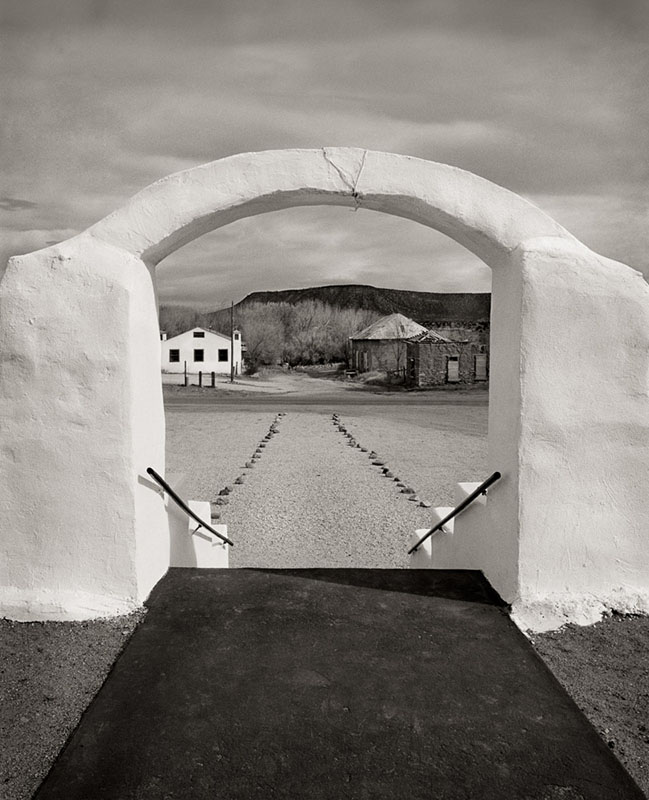
San Miguel, New Mexico
12.5 x 10″, platinum-palladium print with pastel
Prints are numbered and signed
“Joan Myers photographs of the Santa Fe Trail are the record of her travels on the nineteenth-century trade route between Santa Fe and Missouri, enriched and filtered by her unique perspective in this century. In 1822, William Becknell led the first freight wagons from Franklin, Missouri, through southern Kansas, down across northeastern New Mexico to Santa Fe, thus establishing the viability of a trade route soon known as the Santa Fe Trail. Thousands of traders and immigrants along with United States Army troops traveled the Trail until it was superseded by the railroad in 1880.” – University of New Mexico Press
Photographs by Joan Myers of the Santa Fe Trail were shown around the United States as part of a 3‑year SITES (Smithsonian Institution Traveling Exhibition Service) tour, 1986–1989. The book, Along the Santa Fe Trail, with text by Marc Simmons, accompanied the exhibit.
Book | Along the Santa Fe Trail
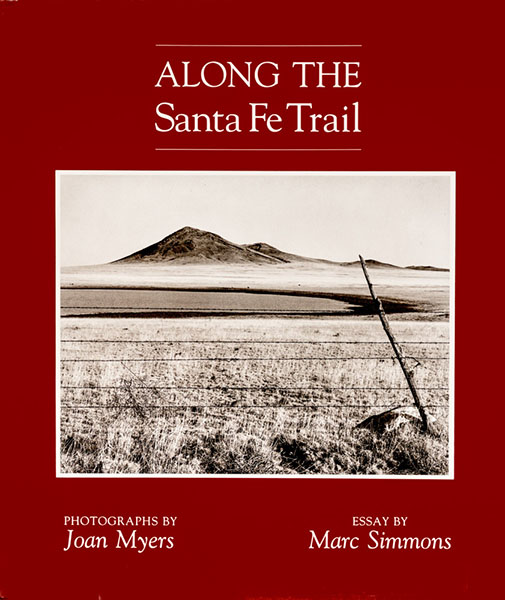
Along the Santa Fe Trail
Photographs by Joan Myers
Text by Marc Simmons
University Of New Mexico Press, 1986, Out of Print
Search for copy on eBay
ISBN: 0–8263-0882–1
Joan Myers’ rich black-and-white photographs of the area surrounding the Santa Fe Trail are accompanied by an historical essay by author Marc Simmons. Text and photographs combine to realize a vivid sense of what the trail was like throughout its 60 years of use and what has become of its remains today. An evocative visual and historical retracing of one of the most important overland trade routes of the nineteenth century.
Artist Statement
It was my challenge to photograph a dream of the past using the landmarks of the Trail and the tangible imagery of the present. I began by reading historical studies and early travel journals. When I traveled to spots on the Trail, I met ranchers, farmers and cafè owners who delighted in showing me how the Trail went through their town or across their field. In all, I traveled over 10,000 miles over a two-year period with by 4x5 view camera, all too often aware of light fading and many miles yet to travel. The sweep and rhythm of the journey exhilarated me as much as it had my nineteenth-century predecessors.
A desert offers a theater of unique assemblages. Each rock and sagebrush, alternately illuminated and obscured by an ever-changing sky, plays a variety of parts. Among these players, we are ever more visible, though our role remains trivial in the natural drama. Though we have demonstrated our power to destroy, we have yet to demonstrate we can positively alter our natural world. The ability of the desert to combine and recombine its disparate elements and to remind the human animal that its possibilities are limited is for me an unending source of fascination.
Press & Quotes
“For Myers, the essence of the Santa Fe Trail became an on-going series of discoveries‑a lived process of finding one’s own way. A quote Myers borrowed from the late English photographer Bill Brandt and copied into her journal perhaps best summarizes that process for her: ‘It is part of the photographer’s job to see more intensely than most people.… He must have and keep in him something of the traveler who enters a strange country.” — Kathleen Shields, New Mexico Magazine (November 1985)
“Joan Myers clearly is a photographer who will not be limited by her medium. She says that the photographic process provides her nothing more than a way of dealing with reality. Although she is aware of her art-historical references, if pressed to name one source of inspiration, she cites the delicacy and sensuality of Japanese literature. Photography seems to be growing increasingly self-conscious, turning often to its own method of depiction for subject matter. In contrast to this looking inward, however, Joan Myers brings a diverse, wide-ranging background to her photographic work. She uses a classical framework without being confined by it.” — Dana Asbury, Artspace (1982)
“Invisible in reproductions of Myers’ photographs is the tactility of the prints, a surface quality that augments the vivid presence of their images. Her printing technique uses platinum and palladium, rather than silver, and requires that she make her emulsion from scratch and brush it on the paper. Then with an enlarged negative, she makes a contact print on all-rag drawing paper. The image is part of the paper, rather than sitting on its surface, creating the effect of photographed detail becoming actual, physical detail. The lush texture and warm tones further manifest the sensuousness and intimacy of experience already suggested by Myers’ imagery.” — Kathleen Shields, New Mexico Magazine (November 1985)
“The images document vanishing historical remains. But they go far beyond that. As an expression of strongly felt love for the land, the photographs are memorable. As markers of an intriguing personal odyssey, they are original and honest statements. As fine-art compositions, they are inventive and elegant.” — Malinda Elliott in Americana (Winter 1985)
“The humility in Joan Myers’ respect for the unspoiled desert and for tradition gives her photographs an openness and magnanimity of spirit, an effect that also makes the images seem inviolate.” — Dana Asbury, Popular Photography (1982)
•
Myers’ early palladium images of desert landscapes were widely shown in the 1980’s. They were printed on a light cream rag paper and have a warm tactile feeling of the land itself.
Myers began experimenting with hand-coated processes in the 1970’s, playing with gum bichromate and carbon printing. In her “Desert Series” she began printing in platinum-palladium, a process that she has used in most of her work thereafter.
Platinum-palladium printing has a tactile feel similar to the landscape. Myers never liked the feel of a conventional silver print with the gelatin sitting on top of paper with the image trapped somewhere inside. With platinum, the paper looks and feels like the drawing paper it is. The image becomes part of the paper.